
Rhythmic vs. Static Hormone Dosing: What the Difference Is and Why I Practice This Way
Most hormone therapy delivers the same dose every day; I practice a different approach, one that restores the monthly rhythm your body was designed around. This is the difference, and these are the honest trade-offs.
You are not losing your mind. You are losing your hormones.
If you’ve already arrived at that understanding, you’ve crossed the threshold most women are never helped across. What comes next is a set of questions: whether to restore your hormones, in what form, and, the one almost nobody raises, in what pattern. Most conversations about hormone therapy cover the first two and never reach the third. The third is where my clinical work has centered, in the approach I’ve been certified in since 2017.
What static dosing is
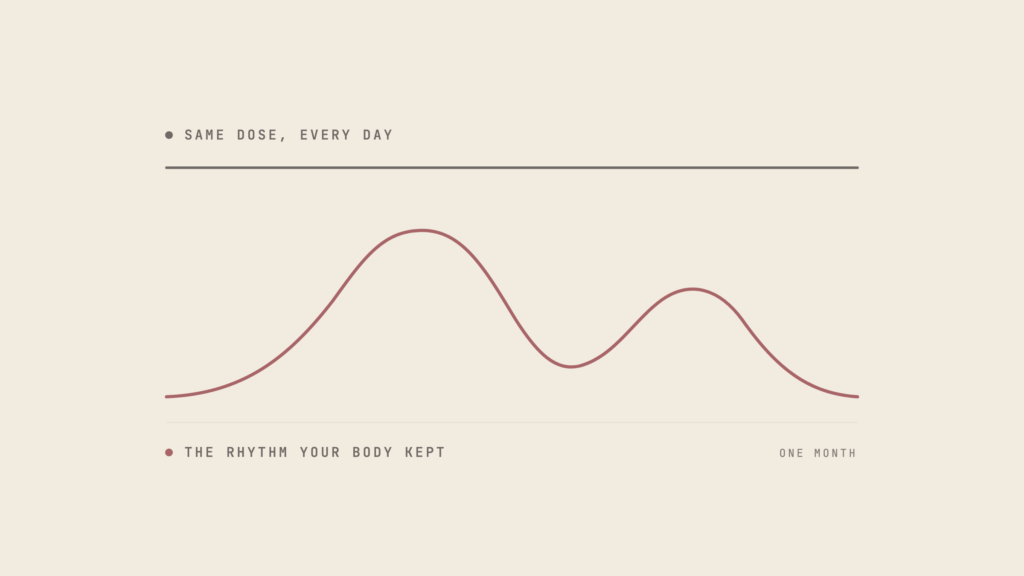
The standard approach to hormone therapy is a constant dose: the same amount every day, delivered by pill, patch, or cream, or by a pellet that releases over months. The goal is a steady level, high enough to quiet symptoms.
There are real virtues in that model. It’s simple to prescribe, simple to follow, and familiar to most physicians. For many prescribers it’s the only model on the table, which is exactly why you may never have been offered an alternative.
What your body was doing before menopause
For all the cycling decades of your life, your hormones never held steady for a single week. Estradiol built through the first half of each month and peaked; progesterone rose through the second half; both fell, the uterine lining shed, and the pattern began again.
That rise and fall carries information. Hormones work like keys turning locks (the locks are receptors, present in your brain, heart, bones, and gut), and the monthly pattern turns those locks in a sequence your physiology is built around. A flat, unchanging level is something your body never produced in its healthiest years.
What rhythmic dosing is
Physiologic Hormone Restoration Therapy® (PHRT®) delivers bioidentical hormones on a cyclical monthly schedule that mirrors the pattern of a woman’s healthiest premenopausal years: estradiol rising and falling across the month, progesterone joining in the second half. I trained in this protocol through the Women’s Hormone Network and have been certified in it since 2017.
Two distinctions sit inside that description, and they’re different distinctions. The first is form: bioidentical hormones are molecularly identical to the ones your body made, which is not the same thing as the synthetic versions used in some older therapies. The second is rhythm, and rhythm is what this article is about. You can be given bioidentical hormones statically; form alone doesn’t restore the pattern.
For women with a uterus, restoring the rhythm restores a monthly shedding of the uterine lining. I use the word “shedding” deliberately, in place of “period,” because it describes what’s happening without the cultural weight. In this protocol, a well-managed monthly shed functions as feedback: visible information about how the pattern is working, which guides how we adjust it.
Foundation first
Hormones introduced into a body running on poor sleep, unresolved gut trouble, or unstable blood sugar will underperform, whatever the dosing pattern. So before any hormone protocol begins, I work with each patient on what I call “hormone readiness”: gut health, metabolic stability, sleep, and nutrition. It can feel like a delay. In practice it’s what gives the protocol a fair chance to do what it was designed to do.
The honest trade-offs
Rhythmic dosing is a minority approach. Most hormone therapy prescribed today is static, and a physician recommending something different owes you a plain account of why she practices that way. That account is this article.
It also asks more of you. The schedule changes across the month, adjustments take attention, and the early months involve more monitoring and conversation than a set-and-forget prescription would.
And the shedding returns. Some women receive that as welcome evidence that their physiology is working again. For others, the return of a monthly bleed is genuinely unwelcome, and I understand why. It deserves a real conversation before you commit, not a footnote after.
The decision of whether to take hormones, and in what pattern, is yours. My job is to lay out the physiology, the options, and the trade-offs clearly enough that the choice you make is one you trust.
If you want to explore whether this fits you
Care at Full Circle Care begins with a first visit, in person at our Murray office or by telemedicine anywhere in Utah, and the care page describes how visits unfold. The simplest first step costs nothing: a 15-minute Fit Call, by phone, with our practice manager, covering how I work, what care costs, and whether we’re the right fit. When you’re ready to find out whether this approach belongs in your plan, schedule the Fit Call.
Have questions about your own picture?
A 15-minute Fit Call is the right next step.